PAPSS lets me pay an African supplier in naira while they receive their local currency - if both banks support the payment route. Before sending even ₦250,000.00, I’d confirm the total debit, the supplier’s net receipt and when they can use the funds.
For my business, the checks are simple:
- Cost and speed: Payments may arrive sooner and involve fewer fees, but I still need to compare bank charges and exchange rates.
- Cash flow and currency risk: Faster payment can help release orders, but local-currency payments still carry exchange-rate risk.
- Access: I need both banks to confirm the route, required documents, payment limits, local rules and available funds.
<u>Business registration alone does not give me PAPSS access.</u> I’d confirm these details before agreeing to a supplier’s payment deadline.
How the Pan-African Payment and Settlement System #PAPSS works
sbb-itb-c37196c
What PAPSS is and how it works
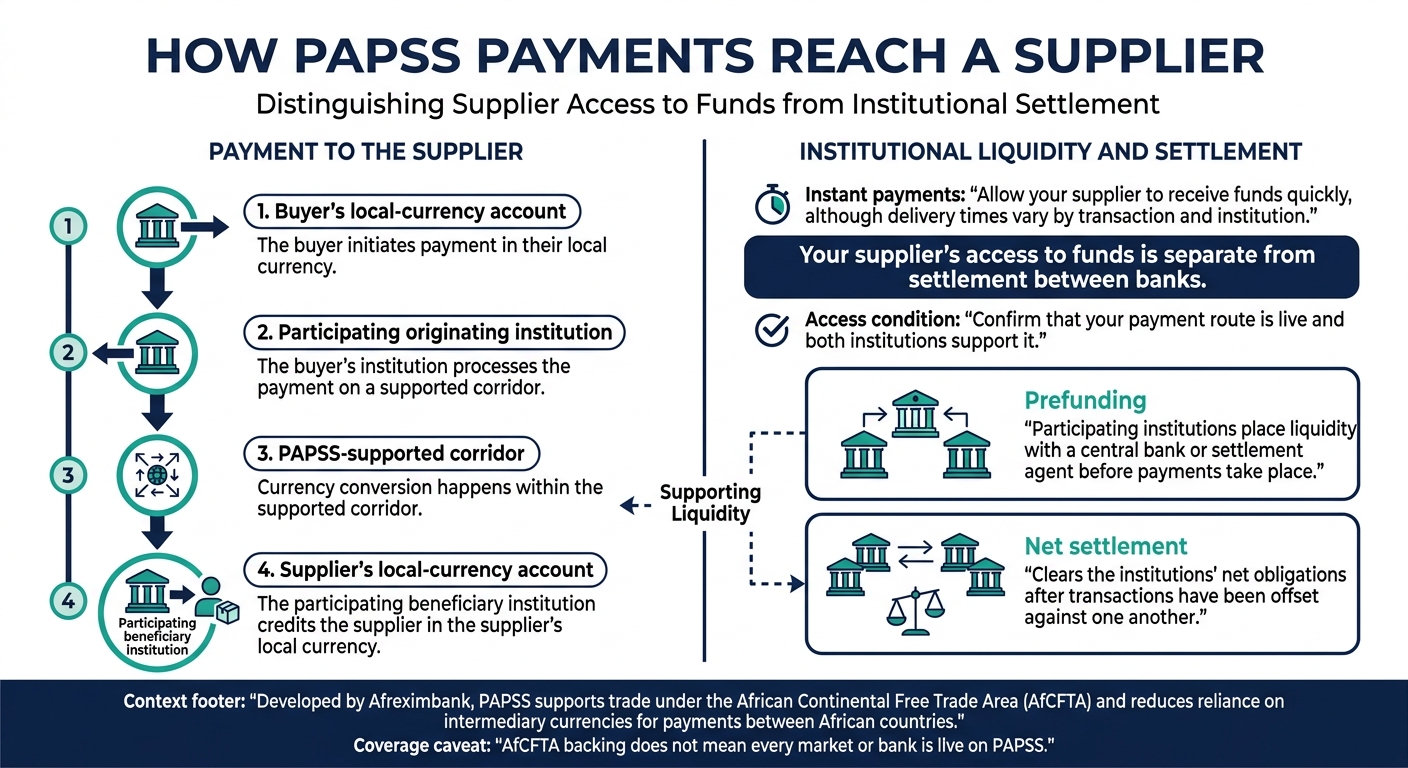
How PAPSS Payments Work
Developed by Afreximbank, PAPSS is a payment infrastructure that supports trade under the African Continental Free Trade Area (AfCFTA). It reduces reliance on intermediary currencies for payments between African countries.
AfCFTA backing does not mean every market or bank is live on PAPSS. For your business, what matters is whether your payment route is live.
How a payment reaches your supplier
A PAPSS payment moves from your local-currency account to your supplier’s local-currency account through participating financial institutions. Currency conversion happens within the supported corridor, so your supplier receives local currency.
This process affects how soon your supplier gets paid and how much of your working capital remains tied up.
Instant payments, prefunding and net settlement
Instant payments allow your supplier to receive funds quickly, although delivery times vary by transaction and institution.
Prefunding means participating institutions place liquidity with a central bank or settlement agent before payments take place. Net settlement clears the institutions’ net obligations after transactions have been offset against one another.
Your supplier’s access to funds is separate from settlement between banks. These processes affect payment speed, fees and currency exposure, which the next section breaks down.
How PAPSS affects costs, cash flow and currency risk
The test is not whether PAPSS exists. It is whether it changes your payment costs, speed and foreign-exchange (FX) exposure on your corridor.
| Business concern | Possible PAPSS effect | Qualification or risk |
|---|---|---|
| Payment speed | Faster crediting can release orders sooner. | Compliance checks, weekends and cut-off times can delay crediting. |
| Transaction costs | Fewer intermediaries may cut some fees. | Bank fees and the FX spread can wipe out savings. |
| Working capital | Faster settlement can help with cash-flow planning. | Delays can still tie up cash. |
| Currency exposure | Reduces reliance on a hard currency. | Converting the buyer’s currency into the supplier’s currency still carries FX risk. |
Payment speed, fees and working capital
Faster payments help cash flow, but faster does not always mean cheaper. Ask when the supplier can use the money - not just when the bank accepts the payment instruction.
Compare the total debit, all fees and the supplier’s net receipt before choosing a route. Allow for compliance checks, weekends and cut-off times. Any gains still depend on whether the corridor is live for both banks.
Why local-currency payments still carry exchange-rate risk
Paying in local currency does not remove exchange-rate risk. Ask how long the quote lasts, when the rate locks and who covers any rate movement. Confirm your final debit and the supplier’s net receipt before approval.
Supplier-payment example: Nigeria to Kenya
Hypothetical payment: A Nigerian importer wants to fund a payment of ₦250,000.00, with its Kenyan supplier receiving Kenyan shillings (KES). A PAPSS payment only works if both the originating Nigerian bank and the beneficiary Kenyan bank are active participants in the specific corridor. The importer should obtain a live quote before approving the debit.
Collect live figures for both routes within the same time window.
| Item to confirm | PAPSS route | Current route |
|---|---|---|
| Amount sent | ₦250,000.00; confirm whether fees are additional | Same funding amount and fee basis |
| Exchange rate | NGN-to-KES rate, spread and expiry | Applicable conversion rate(s), spreads and expiry |
| Originating fee | Exact charge to the importer | Exact charge to the importer |
| Beneficiary fee | Any deduction from the supplier’s proceeds | Any deduction from the supplier’s proceeds |
| Intermediary fee | Confirm whether any applies | Confirm whether any applies |
| Credit time | Bank-confirmed timing and conditions | Bank-confirmed timing and conditions |
| Net receipt | Net KES available to the supplier | Net KES available to the supplier |
The next check is live market and bank access.
PAPSS coverage and business access in 2026
Coverage review: October 2026. Check whether the corridor is live, then confirm the bank, currency and payment deadline with both institutions.
Verify live markets, institutions and corridors
Nigeria appears active through Paystack MFB and Ecobank Nigeria. Zimbabwe is listed as an active corridor through Ecobank Zimbabwe to Ecobank Nigeria, using nominee structures. Kenya is still awaiting approval for a proposed Kenya–Nigeria route.
A live corridor is only the first check. Ask the bank for its account requirements and payment limits before you quote the supplier.
Check account requirements, documents and payment limits
Get the eligibility checklist from both banks for your transaction type. Expect to provide company registration and compliance documents. Some routes also use nominee structures for investment or trade transactions.
Ask about per-transaction, daily and monthly limits, fees and the exchange rate. Confirm how the supplier receives the funds, along with reversal rules and dispute steps.
Some routes also set high minimums; one Zimbabwe-to-Nigeria investment route required US$20,000.
If your payment meets the route’s limits, check whether local rules allow settlement.
Check restrictions before agreeing payment deadlines
Incorporation in a market does not guarantee PAPSS access. In markets such as Ethiopia, foreign-currency registration and sector approvals can block settlement.
Before you agree to a supplier’s deadline, confirm that your bank can process the payment under local rules and that settlement liquidity is available.
Conclusion: is PAPSS right for your trading corridor?
Once you’ve checked corridor coverage, limits and restrictions, decide whether PAPSS fits your payment route. It’s useful only when the corridor, both banks, total cost and FX quote are confirmed.
Use a corridor-level decision checklist
Before agreeing to invoice terms or payment deadlines, use this checklist to decide whether to proceed, ask your bank for confirmation or pause.
| Outcome | Decision criteria |
|---|---|
| Suitable | Both banks are live; the corridor and currencies are supported; charges, FX rate, crediting time, documents and limits are confirmed. |
| Needs bank confirmation | One or both banks are unverified; the corridor, currency, fees, rate, timing or limits are unclear. |
| Not suitable now | The bank or corridor is unsupported; limits prevent payment of the invoice; costs, timing or tracking are unacceptable. |
Authorise payment only after your bank confirms total charges, the FX rate and the expected crediting time.
Plan payment access alongside business setup
Treat PAPSS readiness as a separate step from business registration and bank setup. Don’t commit to supplier terms until you’ve confirmed the corridor, bank and limits.
FAQs
How can I track a delayed PAPSS payment?
Contact customer support at the financial institution you used to make the PAPSS payment. They manage the connection to the PAPSS network and can give you real-time updates on your payment’s status.
The information provided does not explain how to track delayed payments.
Can I cancel a PAPSS payment after authorisation?
No, you cannot cancel a PAPSS payment once it has been authorised. PAPSS settles cross-border payments instantly or almost instantly between participating financial institutions. Once authorised, payments are final and cannot be reversed through the platform.
To avoid errors, check all recipient and transaction details carefully before confirming your payment.
How do I secure an FX quote for my supplier’s invoice?
To get an FX quote for your supplier’s invoice through PAPSS, contact your relationship manager or use your participating commercial bank’s corporate portal. Ask for a quote based on the current PAPSS exchange rates for your currency pair.
Your bank processes the transaction through PAPSS. Check that your account is authorised for cross-border settlements so automated currency conversion and clearing can take place.
Related Blog Posts
From the blog


African Tech, artificial intelligence in Africa, AI investment, South Africa AI policy, Solly Malatsi, digital policy, ai regulations
Malatsi Wants South Africa’s AI Policy Back on Track After False Start
South Africa wants to regain momentum on its national artificial intelligence policy after a drafting scandal forced the government to withdraw its first attempt.