
Choose your company type before drafting your MOI. My starting rule: use a standard MOI for simple ownership arrangements and a customised MOI when you need specific share rights or control terms.
Here’s what I would check before filing:
- Company type: A private company needs at least 1 director; a public company needs at least 3.
- Ownership and control: Set share rights, transfer restrictions, board powers and approval thresholds.
- Legal limits: The Companies Act overrides conflicting MOI terms. A shareholders’ agreement cannot replace the MOI.
- CIPC filing: Check the signed MOI, registration forms, supporting documents and current fees.
- Later changes: MOI amendments usually need a special resolution, with a default 75% approval threshold, followed by filing with CIPC.
My advice: <u>settle the ownership and voting rules before registration</u>, then keep the MOI, company records and filings up to date. Registration is only the start.
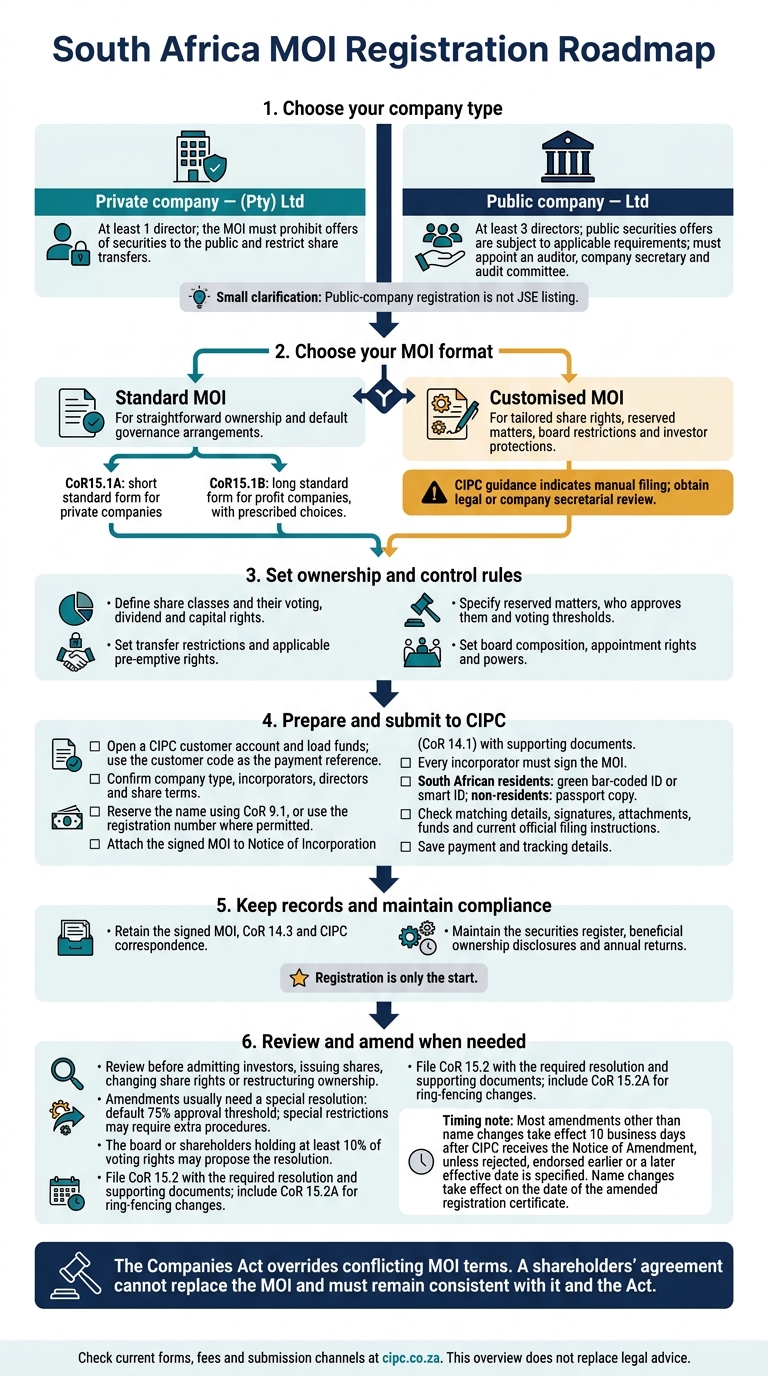
South Africa MOI Registration Roadmap
Company Incorporation & Registration Explained | South African Company Law (Companies Act 2008)
sbb-itb-c37196c
Choose a Company Type and MOI Format
Choose your company type before preparing registration documents. Let your capital plans, control over share transfers, and governance needs guide the decision.
Private vs Public Company Rules
Registering a public company with CIPC does not mean it is listed. Listing on the Johannesburg Stock Exchange (JSE) is a separate process with extra requirements.
| Issue | Private company - (Pty) Ltd | Public company - Ltd |
|---|---|---|
| Public securities offers | The MOI must prohibit offers of securities to the public. | May offer shares to the public, subject to applicable public-offer and prospectus requirements. |
| Share transfers | The MOI must restrict the transfer of shares. | Shares are generally freely transferable. |
| Minimum directors | At least 1 director. | At least 3 directors. |
| Accountability | May need an audit or independent review, depending on its Public Interest Score. | Must appoint an auditor, company secretary, and audit committee. |
| Drafting needs | A short standard MOI may suit a simple, owner-managed business. | The MOI must cover public-company governance and accountability requirements. |
Once you have chosen the company type, decide whether a standard MOI fits or you need tailored terms.
Standard vs Custom MOIs
CoR15.1A is the short standard form for private companies. CoR15.1B is the long standard form for profit companies, offering more choices within a prescribed structure.
| Issue | Standard MOI | Customised MOI |
|---|---|---|
| Flexibility | Uses statutory defaults and, in the long form, prescribed choices. | Allows tailored terms where the Act permits changes. |
| Drafting work | Needs less drafting, but founders must still check that the selected provisions fit. | Needs careful drafting, preferably with legal or company secretarial support. |
| Submission route | Standard MOIs form part of the CIPC registration process. | CIPC guidance indicates manual filing. |
| Governance control | Suits businesses where default decision-making rules are sufficient. | Can cover reserved matters, board restrictions, and investor protections. |
| Best fit | Straightforward, owner-managed businesses. | Businesses that need different rights for different share classes or negotiated control arrangements. |
Set investor rights before filing. Share classes, consent rights, and reserved matters may call for a custom MOI, but mandatory law still applies.
Next, define share rights, reserved matters, and board powers in the MOI.
Set Share Rights, Reserved Matters and Board Powers
Once you’ve chosen the MOI format, set the control rights and approval thresholds. Start with ownership rights, then control rights, and finish with board powers.
Share Classes, Rights and Transfers
Define each share class’s voting, dividend and capital rights. Under section 37, shares in the same class have identical rights, limitations and terms unless the MOI states otherwise. In private companies, existing shareholders have pre-emptive rights over new share issues, subject to section 39. The MOI may limit or exclude these rights.
Reserved Matters and Voting Thresholds
For each reserved matter, state who must approve it and the voting threshold. Include only matters that the Act allows the MOI to regulate.
MOI amendments generally need a special resolution, with a default approval threshold of 75%. Special restrictions on amendments may require extra procedures.
Longer meeting notice periods and higher board quorums can give minority investors stronger protection.
Director Powers and Appointments
The board must act within the Act and the MOI. Set out appointment rights, board composition and matters that need shareholder approval.
Use board rules only for procedural matters that the Act or MOI does not already cover. These rules must remain consistent with both.
Once these terms are fixed, file the MOI with CIPC.
Prepare and File the MOI with CIPC
Filing Forms, Documents and Fees
Once the MOI terms are settled, open a CIPC customer account and load funds. Use your customer code as the payment reference. Before completing the application, confirm the company type, incorporators, directors and share terms. Reserve the company name using CoR 9.1, or use the company registration number where permitted.
Attach the signed MOI to the Notice of Incorporation (CoR 14.1), together with the supporting documents. Every incorporator must sign the MOI. South African residents must provide a green bar-coded ID or smart ID, while non-residents must provide a passport copy.
Check the official Companies and Intellectual Property Commission website for current forms, submission channels, fees in rand and filing instructions. Custom MOIs may need manual attachments. Have a legally qualified person or company secretarial expert review yours before filing.
Submission Checks and Record-Keeping
Before submitting, check that the name, company type, incorporator and director details match across all documents. Review the share classes and terms, signatures and attachments, and confirm that your account has enough funds. Save the payment reference and application tracking details. Follow up only after CIPC’s published turnaround time has passed.
After filing, retain the registered documents in the company’s records, including the signed MOI, CoR 14.3 and all CIPC correspondence. Registration does not replace the duties to maintain the securities register, submit beneficial ownership disclosures or file annual returns.
Conclusion: Keep the MOI Fit for Your Company
After registration, keep the MOI up to date as your company’s governance needs change. A standard MOI suits simple governance arrangements. Custom rights and restrictions need a tailored MOI. Keep the shareholders’ agreement in line with both the MOI and the Companies Act - any inconsistent terms are void.
Before changing ownership or control, review the MOI.
When and How to Amend the MOI
Review the MOI before admitting investors, issuing shares, changing share rights or restructuring ownership. Director changes usually don’t need an amendment unless the MOI limits appointments or powers.
Amendments usually require a special resolution. The board or shareholders holding at least 10% of voting rights may propose it. File CoR 15.2 with the required resolution and supporting documents. For ring-fencing changes, include CoR 15.2A.
Most amendments other than name changes take effect 10 business days after CIPC receives the Notice of Amendment, unless the Commission rejects it, endorses it earlier or a later effective date is specified. Name changes take effect on the date of the amended registration certificate.
Check the documents once more before filing.
Final Filing Checklist and Registration Support
Confirm the company type, MOI format, share classes and rights, board powers, and approval thresholds.
AfroForm provides company registration administration support in South Africa and other African markets. This support does not replace legal advice or guarantee CIPC acceptance.
FAQs
Can I replace a standard MOI as my business grows?
Yes, you can replace or amend your Memorandum of Incorporation (MOI) as your business grows. Many private companies begin with a standard MOI, then update it as their needs change - for example, to waive specific audit requirements or change shareholder rules.
To make an amendment, file a Notice of Amendment (Form CoR 15.2) with the CIPC. All amendments must comply with the Companies Act. Major governance changes also need careful drafting.
How can my MOI prevent shareholder deadlocks?
In South Africa, a customised Memorandum of Incorporation (MOI) can help prevent shareholder deadlocks by setting governance rules beyond the default legal provisions. It can specify meeting quorum requirements, adjust voting percentages for ordinary or special resolutions, and set clear steps for resolving disagreements.
The MOI is a binding contract between the company and its shareholders, providing a legal framework for handling disputes and keeping the business running.
What happens if CIPC rejects my MOI?
If CIPC rejects your Memorandum of Incorporation (MOI), you cannot reuse the queried or rejected application. You’ll need to enter the information again and get a new tracking number.
Review the reasons for rejection, which may include using the wrong form or not meeting the filing requirements. Check that all required supporting documents are correctly attached, then finalise the new application within the prescribed timelines.
Related Blog Posts
From the blog



artificial intelligence in Africa, AI investment, startup funding, African venture capital, African tech ecosystem, African AI startups, voice AI
What African Investors Really Want to See Before Funding an AI Startup
Artificial intelligence is making it easier and cheaper to build software. Across Africa, founders are using the technology to develop everything from voice assistants that understand local languages to tools that help...