
Africa’s state investment funds hold about US$164 billion as of June 2026, but the main point is simple: mandate and control matter more than headline size.
If I were scanning this list for business or investment use, I would focus on three things first:
- who funds the vehicle - oil, gas, diamonds, SOE assets, or budget transfers
- what the fund is built to do - savings, fiscal buffer, development, or a mix
- whether it acts like a passive reserve pool or an active deal partner
Here’s the short version of the full article:
- Ethiopian Investment Holdings has the biggest estimated asset base at about US$150 billion, but much of that comes from grouped state firms, not a plain cash pool
- Libya’s LIA remains one of the biggest at about US$70 billion, though politics and legal issues weigh on how investors read it
- Algeria’s FRR is more of a budget-shock buffer than a partner for private deals
- Angola’s FSDEA, Nigeria’s NSIA, Morocco’s Mohammed VI Fund, and Senegal’s FONSIS stand out more for deal flow and state-backed project activity
- Botswana’s Pula Fund and Ghana’s petroleum funds are useful fiscal signals, but repeated withdrawals matter
- Rwanda’s Agaciro is smaller, yet its local funding story gives it a different investor signal
So if you only take one thing from this ranking, let it be this: a fund with lower AUM but cleaner rules and clearer deal activity may matter more to you than a much bigger fund on paper.
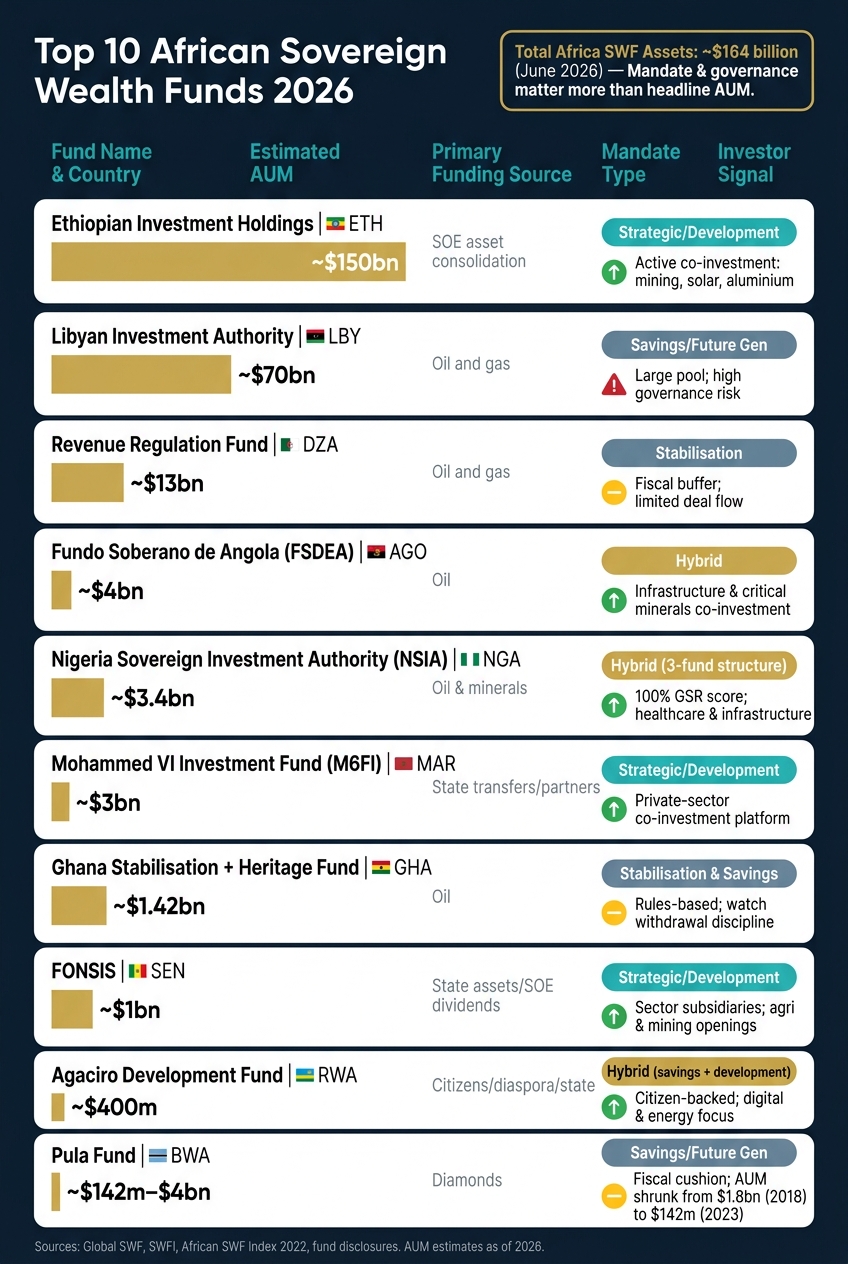
Top 10 African Sovereign Wealth Funds 2026: AUM, Mandate & Investor Signal
How African Sovereign Wealth Funds Are Accelerating Investments | Middle East & Africa Summit 2025
sbb-itb-c37196c
Quick comparison
| Fund | Country | Est. AUM | Main funding source | Main role | Investor read |
|---|---|---|---|---|---|
| Ethiopian Investment Holdings | Ethiopia | ~US$150bn | SOE assets | State investment platform | Active project and co-investment route |
| Libyan Investment Authority | Libya | ~US$70bn | Oil and gas | Long-term savings | Big pool, but governance risk |
| Revenue Regulation Fund | Algeria | ~US$13bn | Oil and gas | Fiscal buffer | More macro signal than deal partner |
| Fundo Soberano de Angola | Angola | ~US$4bn | Oil | Mixed mandate | State-backed project activity |
| Nigeria Sovereign Investment Authority | Nigeria | ~US$3.4bn | Oil and minerals | Mixed mandate | Strong governance and sector co-investment |
| Mohammed VI Investment Fund | Morocco | ~US$3bn | State capital and partners | Development fund | Private-sector partnership route |
| Ghana Stabilisation Fund + Heritage Fund | Ghana | ~US$1.42bn | Oil | Savings and fiscal support | Watch withdrawals and policy use |
| FONSIS | Senegal | ~US$1bn | State assets and SOE dividends | Development fund | Active in local sectors |
| Agaciro Development Fund | Rwanda | ~US$400m | Citizens, diaspora, state | Savings + development | Public-backed state capital signal |
| Pula Fund | Botswana | ~US$142m to US$4bn | Diamonds | Savings and reserve support | Fiscal cushion more than deal flow |
If I were ranking these from a market-entry angle, I would watch NSIA, EIH, FSDEA, M6FI, and FONSIS most closely, because they show where state money is being used in live sectors, not just stored.
Africa's sovereign wealth fund landscape in 2026
Before the ranking, one point matters. Africa's state funds usually sit in two main camps.
Some are classic savings funds set up to protect commodity windfalls over time. Others work more like state holding companies, bringing government-owned firms under one roof. Both appear on this list because both control large pools of capital and both shape investor conditions.
Oil, gas, and minerals remain the main capital source
Most of Africa's biggest funds still rely on oil, gas, diamonds, or minerals. That gives them deep funding, but it also ties them closely to commodity cycles.
Libya's Libyan Investment Authority (LIA), estimated at $68 billion to $70 billion, was built on oil revenues. Algeria's Revenue Regulation Fund depends on gas export surpluses. Angola's FSDEA and Nigeria's NSIA were both seeded with oil receipts. Botswana's Pula Fund draws from diamond royalties. Ghana's funds tap crude oil proceeds.
So there are two sides to the story. Resource dependence can fill a fund fast when prices are high. But when prices fall, pressure shows up just as fast.
Development platforms sit alongside classic savings funds
Not every entity here fits the old-school SWF model. Ethiopian Investment Holdings (EIH) brings together around 30 state companies, with asset estimates ranging from $45 billion to $150 billion.
Morocco's Mohammed VI Investment Fund directs state capital into local sectors and private partnerships. These are state-backed investment platforms, and they are tracked alongside SWFs because of their size, deal flow, and effect on market conditions.
For investors, that difference is not small. A classic savings fund may lean towards wealth preservation and offshore assets. A state holding platform may be more focused on local industry, state assets, and direct deal-making.
Why fund structure matters for investors
A fund's setup tells you a lot about the market around it. It can hint at policy direction, risk appetite, and the kind of deals that are likely to show up.
The table below breaks that down:
| Fund Type | Main Goal | Typical Capital Source | Signal to Investors |
|---|---|---|---|
| Stabilisation | Buffer fiscal volatility | Oil/gas export revenues | Fiscal buffer, limited co-investment appetite |
| Savings / Future Gen | Long-term wealth preservation | Commodity windfalls | Long-term horizon, global diversification |
| Strategic / Development | Domestic economic growth | SOE equity, state transfers | Co-investment focus, sector-specific risk |
| Hybrid | Buffer + growth | Mixed (resources + budget) | Balanced risk, flexible mandate |
That setup shapes how investors should read each market. Across Africa, sovereign wealth funds are moving beyond pure fiscal buffering and stepping further into domestic investment. Knowing which fund type leads in a market helps investors judge policy direction, weigh risk, and spot where co-investment openings may sit.
1. Libyan Investment Authority (Libya)
Estimated AUM: about $70 billion | Founded: 2006 | Global Rank: 25th largest SWF worldwide
Africa's largest fund sets the pace on size - and also shows how governance risk can shape investor confidence.
Founded in 2006 and financed by oil and gas revenue, the Libyan Investment Authority is a classic savings fund built to preserve national wealth. Its portfolio covers equities, bonds, real estate, infrastructure, and private equity.
The fund stays under close watch because political instability and legal disputes have put its governance under pressure. In 2018, a benchmarking index gave it a score of just 2.00% for governance and transparency. For foreign investors, LIA is a clear reminder that size on its own doesn't make a market easy to trust or enter. That scale still makes it a key reference point for the rest of the list.
2. Ethiopian Investment Holdings (Ethiopia)
Estimated AUM: about $150 billion | Founded: 2022 | Mandate: Strategic Development / National Asset Management
Ethiopian Investment Holdings, or EIH, is Africa’s largest SWF by estimated AUM. It came together by bringing about 30 state-owned enterprises under one holding structure. So this isn’t a classic savings fund sitting on a pool of cash. It’s a state-led investment platform built to take an active hand in major assets.
Its portfolio includes big-name assets like Ethiopian Airlines and Ethio Telecom. At launch in 2022, its holdings were valued at around $45 billion. By 2026, that figure had grown to an estimated $150 billion. EIH also takes direct equity stakes, works to modernise state enterprises, and uses co-investment structures to bring in foreign capital.
That active role showed up in 2026, when EIH backed potash, solar, and aluminium projects with partners in Ethiopia and abroad. In plain terms, it isn’t just holding assets on paper. It is putting capital to work in sectors the state sees as important.
For foreign investors, that matters. EIH can signal clear state commitment and help reduce perceived political risk. At the same time, the $150 billion figure needs a careful read, because SOE valuations are not the same thing as liquid AUM. That makes EIH less useful as a straight cash comparison and more useful as a marker of state-backed capital, deal flow, and co-investment openings.
3. Revenue Regulation Fund / Algeria Sovereign Wealth Vehicle (Algeria)
Estimated AUM: ~US$13 billion | Mandate: Economic stabilisation / fiscal buffer
Next is Algeria. This fund is built for macro stability, not active deal-making.
Algeria's Revenue Regulation Fund (FRR) is a fiscal buffer funded by oil and gas surpluses. Latest estimates put AUM at about US$13 billion.
Its main job is economic stabilisation and budget support. In plain terms, it helps the state keep spending when energy revenues drop.
For foreign investors, the main issue is governance and transparency. Its governance and transparency score was 2%, which points to weak disclosure and limited independence.
So FRR is better read as a signal for fiscal stability than as a source of private co-investment.
4. Fundo Soberano de Angola (Angola)
Estimated AUM: ~US$4 billion | Mandate: Hybrid - Stabilisation, Savings, and Development
Established in 2011 with a US$5 billion endowment, FSDEA is funded mainly by oil revenues and mineral royalties. Since 2017, the fund has gone through a major governance reset. That shift shows in the numbers: it now has a transparency score of 8 out of 10 from the Sovereign Wealth Fund Institute, and it ranked 2nd overall in the 2022 African Sovereign Wealth Funds Index with a score of 68.60%.
You can also see that shift in where the money is going. FSDEA is now putting capital into domestic projects, including the US$1 billion Lobito Corridor rail project - linking Angola, Zambia, and the Democratic Republic of Congo. It has also taken equity positions in the Longonjo rare earth project. That points to a clear focus on infrastructure and critical minerals.
The fund also posted a record net profit in 2023, with results that were more than triple its 2022 performance. For foreign investors, FSDEA matters less as a passive fiscal buffer and more as a co-investment signal. In plain terms, when the fund takes an equity stake in a commercial project, it can lower perceived political risk for international partners looking at the Angolan market.
That change in governance, paired with its sector focus, makes FSDEA one of the more interesting African sovereign wealth funds to track. It also serves as a useful reference point for how African SWFs can move beyond savings and play a direct role in development.
5. Pula Fund (Botswana)
Estimated AUM: estimates range from about US$142 million to roughly US$4 billion | Mandate: Hybrid - Stabilisation and Savings
Established in 1993 and managed by the Bank of Botswana, the Pula Fund is financed mainly by diamond export earnings and surplus foreign exchange reserves. It stands out as one of Africa's clearest resource-backed stabilisation funds. But unlike some of the bigger state vehicles ranked above it, the Pula Fund works mostly as a reserve buffer.
The fund was set up to preserve national wealth, yet repeated fiscal withdrawals have made its reported size swing sharply. Reported assets dropped from about US$1.8 billion in 2018 to roughly US$142 million by August 2023, even though some aggregated lists still put it closer to US$4 billion. That gap tells you something straight away: headline AUM on its own doesn't give the full picture.
Botswana also faces a clear concentration risk. Diamonds make up roughly 80% of exports and about one-third of fiscal revenue, which leaves the fund exposed to diamond-cycle shocks and pressure from lab-grown diamond competition. So for foreign investors, the bigger signal is not just the fund's size. It's the stress on Botswana's fiscal buffers.
That is why the Pula Fund matters more as a stability indicator than as a co-investment platform. It invests conservatively in global equities and bonds, and it is governed under the Santiago Principles. In the 2022 African Sovereign Wealth Funds Index, it ranked 5th overall with a score of 64.20%, but its funding-diversity score was only 2.50%. Put simply, the issue is limited funding depth, not scale. The revenue base is narrow, and that leaves less room when commodity conditions turn.
Botswana is also planning a second vehicle aimed at restructuring loss-making state enterprises, with funding drawn from returns only, not capital. If that vehicle launches, it could shift how investors view Botswana. For now, though, the country's main sovereign fund story is still about fiscal cushioning, not active deal-making.
6. Nigeria Sovereign Investment Authority (Nigeria)
Estimated AUM: about US$3.4 billion (about ₦4.91 trillion) | Mandate: Hybrid - Stabilisation, Savings, and Development
NSIA is one of Africa’s clearest examples of a hybrid sovereign fund. It serves as a stabilisation buffer, a long-term savings vehicle, and a local investor all at once.
Set up by an Act of the National Assembly in 2011 and seeded with US$1 billion, NSIA draws funding from hydrocarbon and mineral royalties, government contributions, and investment returns. It has recorded 13 straight years of earnings and asset growth, with a compound annual growth rate of nearly 11%.
NSIA operates through three funds:
- Stabilisation Fund: holds liquid, conservative assets to cushion short-term macro shocks
- Future Generations Fund: invests in diversified global equities and bonds for long-term capital appreciation
- Nigeria Infrastructure Fund: channels capital into healthcare, power, roads, agriculture, and digital infrastructure
In 2025, these funds returned 15.44%, 14.55%, and 9.27%, respectively.
This three-part structure is a big part of why NSIA matters beyond its size. It can fund projects, not just sit on capital. Its Medserve platform has helped build a network of diagnostics and cancer-treatment centres across Nigeria through co-investment with private partners. It has also worked with Japan’s JICA to provide start-up financing and venture capital for Nigerian tech firms and startups, which shows how NSIA uses a blended-finance model.
In 2026, NSIA earned a perfect 100% score on the Global SWF Governance, Sustainability and Resilience (GSR) Scoreboard - one of only nine institutions in the world to do so. That track record makes NSIA more attractive to co-investors and sends a strong signal of institutional discipline to foreign investors looking at Nigeria. For those looking to enter the market, registering a company in Nigeria is the first step toward leveraging these institutional improvements.
7. Mohammed VI Investment Fund (Morocco)
Estimated AUM: about US$3 billion | Mandate: Development / Strategic Investment
Like other African development platforms, M6FI is built to draw private capital into priority sectors. Morocco's Mohammed VI Investment Fund (M6FI) is a state-backed development and strategic investment fund with about US$3 billion in assets.
The fund co-invests in domestic projects and helps mobilise private capital. Its job is fairly clear: support private-sector growth and key development projects, while still generating returns. It launched with an initial equity base of US$1.5 billion and aims to mobilise a total of US$5 billion by bringing in investment partners.
M6FI invests through sector-focused portfolios, including:
- Infrastructure
- Healthcare
- Industry
- SMEs
That makes it a solid reference point for investors looking at state-backed co-investment in North Africa.
For foreign investors, M6FI points to co-investment openings in Morocco's priority sectors.
8. Ghana Stabilisation Fund and Ghana Heritage Fund (Ghana)
Estimated AUM: about US$1.42 billion combined, as at end of H1 2025 | Mandate: Fiscal stabilisation and long-term savings
Ghana operates two petroleum funds under the Petroleum Revenue Management Act. The Ghana Stabilisation Fund helps cushion the budget when oil revenue falls short, while the Ghana Heritage Fund saves wealth for the period after petroleum reserves run down.
Both funds are managed by the Bank of Ghana, with parliamentary oversight and public reporting. That setup gives Ghana one of Africa's more open commodity-funded vehicles.
As at June 2025, the Heritage Fund stood at US$1.36 billion, while the Stabilisation Fund held about US$60 million. That wide gap comes from repeated budget support withdrawals from the GSF. In plain terms, this points to budget strain, not just a portfolio choice.
For foreign investors, Ghana's petroleum funds matter less as a direct co-investment route and more as a sign of how the state handles resource money. Amendments to the Petroleum Revenue Management Act have loosened spending rules to permit infrastructure financing. That suggests a stronger push to use sovereign capital for local development.
The part to watch is how those revised rules are applied. They can move savings toward near-term political spending. That tension between fiscal discipline and policy room makes Ghana a useful contrast with the next fund on the list.
9. Agaciro Development Fund (Rwanda)
Estimated AUM: about US$400 million as at September 2026 | Mandate: cut aid dependence and build long-term domestic capital
Rwanda brings a different model to Africa's sovereign wealth space. Agaciro Development Fund is not a classic resource-funded SWF. It was first funded by Rwandan citizens, the diaspora, and the private sector, with later transfers from government. As at September 2026, it holds about US$400 million. “Agaciro” means dignity in Kinyarwanda.
That origin matters. Because everyday Rwandans put money into the fund, any move to raid it comes with a political and public-image cost. In plain terms, that public backing helps protect the fund from emergency government withdrawals. It also gives investors a stronger read on Rwanda’s fiscal discipline.
The fund holds about 70% in equities and 30% in government securities. It is also targeting data centres and power generation as part of Rwanda’s push into digital services. On size, the goal is clear: reach US$1 billion in AUM.
For foreign investors, Agaciro sends a simple message: the state has skin in the game, and there is a public-sector partner that is willing to back projects in Rwanda’s ICT and energy sectors. That gives the fund extra weight as a signal of state commitment in Rwanda’s infrastructure and digital economy.
10. FONSIS - Fonds Souverain d'Investissements Stratégiques (Senegal)
Estimated AUM: about US$1 billion as at September 2026 | Mandate: support domestic development through co-investment in key sectors
Senegal's FONSIS is smaller than some of Africa's better-known sovereign funds, but it has stayed active. It is Senegal's state-backed strategic investment fund, with about US$1 billion in assets, funded by state asset transfers, privatisation proceeds, and SOE dividends. Set up in 2012, it is treated as a hybrid fund with both development and savings mandates.
The fund works through five specialised subsidiaries across healthcare, agriculture, real estate, private equity, and infrastructure. In plain terms, each unit focuses on one part of the economy, while all of them still sit under one sovereign investment platform.
FONSIS has also taken on a clearer co-investment role. In June 2026, it started co-investing in Senegal's first gold refinery alongside the Société des Mines du Sénégal. The project is meant to bring artisanal miners into formal supply chains and keep more value in-country through local processing. That move fits Senegal's broader push to process more of its raw materials at home instead of exporting them earlier in the value chain.
In the 2022 African Sovereign Wealth Funds Index, FONSIS ranked 4th in Africa with a 64.40% score and 35.00% for governance and transparency. For foreign investors, FONSIS points to co-investment openings and policy alignment in Senegal. It also serves as a useful benchmark in the comparison table below.
Quick comparison table: all 10 funds at a glance
For a quick cross-country scan, use the table below. It turns the ranking into a simple investor screen. And one thing stands out fast: mandate matters more than size.
| Fund | Country | Region | Est. AUM (US$) | Primary Funding Source | Mandate Type | Key Signal for Foreign Investors |
|---|---|---|---|---|---|---|
| Libyan Investment Authority | Libya | North Africa | ~$70bn | Oil and gas | Savings / future generations | Largely passive; focused on asset protection |
| Revenue Regulation Fund | Algeria | North Africa | ~$13bn | Oil and gas | Stabilisation | Buffers budget volatility; signals macro stability |
| Mohammed VI Investment Fund | Morocco | North Africa | ~$3bn | State transfers / partners | Strategic / development | Strategic co-investment platform; targets SMEs and industry |
| Ethiopian Investment Holdings | Ethiopia | East Africa | ~$150bn | SOE asset consolidation | Strategic / development | Active co-investment in mining and SOE modernisation |
| Agaciro Development Fund | Rwanda | East Africa | ~$400m | Voluntary contributions / state | Hybrid (savings + development) | Citizen-backed; focus on digital services and energy |
| Nigeria Sovereign Investment Authority | Nigeria | West Africa | ~$3.4bn | Oil | Hybrid (stabilisation + savings + development) | Perfect 100% GSR score; co-invests in healthcare and infrastructure |
| Ghana Stabilisation Fund and Ghana Heritage Fund | Ghana | West Africa | ~$1.42bn | Oil | Stabilisation & savings | Rules-based structure; dual-fund design |
| FONSIS - Fonds Souverain d'Investissements Stratégiques | Senegal | West Africa | ~$1bn | State assets / SOE dividends | Strategic / development | Sector subsidiaries; co-investment openings in agri and mining |
| Fundo Soberano de Angola | Angola | Southern Africa | ~$4bn | Oil | Hybrid (stabilisation + savings + development) | Infrastructure and critical minerals |
| Pula Fund | Botswana | Southern Africa | ~$142m–$4bn | Diamonds | Savings / future generations | Long-term savings; withdrawals have shrunk the fund |
Across Africa, SWFs are moving beyond their old role as fiscal buffers and stepping into a more active investment role. That shift matters. A big fund can look impressive on paper, but it doesn't always mean easy market entry. For those looking to launch in Africa quickly, understanding these mandates is the first step.
A better way to read the table is to start with the mandate column. Stabilisation funds usually point to macro buffer strength. Strategic and development funds, on the other hand, tend to show where co-investment doors may be open.
What foreign investors should take note of
Foreign investors should look at SWFs by mandate first. That tells you far more than fund size alone.
Why? Because the fund type shows whether a vehicle is mainly a fiscal buffer or a serious deal partner. The table below helps sort funds by investor signal, not just headline AUM.
Resource-backed savings funds
Funds like the Botswana Pula Fund and Ghana Heritage Fund were set up to turn finite natural resources into long-term financial capital.
For investors, the signal is pretty clear: these funds are tied to commodity price cycles and government withdrawals. So even when AUM looks large on paper, the capital base may be less steady than it seems.
Stabilisation funds
Algeria's Revenue Regulation Fund and Ghana's Stabilisation Fund serve as fiscal buffers. Their main role is to support macro stability, not to drive deal flow.
Development and state investment platforms
The strongest entry points tend to sit with development funds, not savings funds.
Ethiopia's EIH, Morocco's Mohammed VI Investment Fund, and Senegal's FONSIS are active co-investors rather than passive reserve holders. They often come with sector mandates and, in some cases, specialised subsidiaries built to bring in foreign partners.
Fund types and investor signals: comparison table
The table below turns fund types into investor signals.
| Fund Type | Capital Source | Primary Mandate | Co-investment Potential | Key Risk |
|---|---|---|---|---|
| Resource-backed Savings | Commodity windfalls (oil, diamonds) | Long-term wealth preservation | Low - mainly focused on preserving capital | Commodity price exposure; risk of government withdrawal |
| Stabilisation | Commodity export revenues | Fiscal buffering against price swings | Very low - built for liquidity, not deal-making | Limited relevance for private-sector partnerships |
| Development / Strategic | SOE equity, state transfers, royalties | Domestic infrastructure and industrialisation | High - mandated to crowd in private capital | Governance quality varies; verify board independence |
| Hybrid | Mixed (resources + state assets) | Stabilisation + savings + infrastructure | Moderate to high - depends on the sub-fund | Complexity; you need to identify which pool you are engaging |
Nigeria focus: what NSIA means for Nigerian readers
For Nigerian readers, NSIA is less about a headline balance-sheet number and more about what it says about how public money can help business growth. It matters because it puts state capital into three separate pools, and each one has a different job.
NSIA's three-fund structure
The Stabilisation Fund keeps liquid, conservative assets that can help cushion the national budget when fiscal shocks hit. It returned 9.27% in 2025.
The Future Generations Fund is built for the long term. Its role is to grow capital for future citizens through a diversified global mandate. In 2025, it returned 15.44%, beating its benchmark by 8 percentage points.
The Nigeria Infrastructure Fund (NIF) supports healthcare, agriculture, power, and other priority infrastructure, with a clear push to bring in private capital alongside public funds. Its Medserve platform has built a national diagnostics and cancer-treatment network.
That three-way split makes NSIA more useful to investors than a plain savings fund. One part protects the budget, one part builds for the future, and one part backs sectors that can shape day-to-day economic activity.
Why NSIA draws attention beyond its size
At about US$3.4 billion, NSIA is not the biggest fund on this list. But that is not why people study it.
As of 2026, NSIA is one of only nine state-backed investors worldwide to earn a perfect score on the Global SWF Governance, Sustainability and Resilience (GSR) Scoreboard.
That record rests on 13 straight years of earnings, with total assets reaching nearly ₦4.91 trillion in 2025. Just as important, the three pools are kept separate from one another, which helps shield the fund from political interference.
How to benchmark NSIA against other African funds
NSIA is smaller than Libya's LIA and Ethiopia's EIH, but its governance scores are much stronger. Its mandate is also more active than passive savings funds such as Botswana's Pula Fund, which fell from US$1.8 billion in 2018 to about US$142 million after repeated government withdrawals.
For anyone looking at market entry, that is the main angle to watch: which NSIA-backed sectors are open to co-investment.
What SWF-linked markets mean for business expansion
How SWFs affect market entry conditions
For foreign investors, the main question is simple: which funds give you actual access to a sector?
When an SWF backs a sector, it can reduce perceived risk and pull in extra capital. In plain terms, the fund becomes a lead investor, and that often draws private co-financing alongside it.
You can see that pattern in a few markets already.
Angola's FSDEA committed US$1 billion to the Lobito Corridor rail project in 2024–2025. The project is a major infrastructure link between Angola, Zambia, and the Democratic Republic of Congo, with the goal of improving regional mineral exports.
In Ethiopia, EIH entered a solar power joint venture with the UAE's Masdar to develop renewable energy capacity as part of its mandate to modernise state assets. It also partnered with RUSAL on a US$1 billion aluminium smelter meant to support downstream beneficiation. For investors, that's the signal to watch. It shows where state-backed capital is helping shape market access.
Co-investment on commercial terms can also make the operating climate steadier than a setup where the state only regulates or taxes the sector. Senegal's FONSIS is one example. It is co-investing in the country's first gold refinery alongside Société des Mines du Sénégal.
Practical setup needs when entering SWF-linked markets
Once the investment case looks good, execution is usually where things slow down.
The setup process often includes:
- company registration
- bank account opening
- annual filings
- local hiring
- property acquisition
- residency or citizenship processes
Each of these steps comes with country-specific rules. What works in Nigeria may not match the rules in Angola, Ethiopia, or Rwanda.
AfroForm helps businesses handle registration, banking, filings, hiring, property acquisition, and residency or citizenship steps in Angola, Botswana, Ethiopia, Ghana, Nigeria, Rwanda, and other SWF-linked markets.
Conclusion
Africa’s sovereign wealth funds held $164 billion in June 2026, and that figure may climb as more funds get broader mandates. But the bigger story isn’t just size. It’s how each fund is run, and what it is allowed to do.
Size counts. Governance and mandate count more. For investors, strong governance and strict withdrawal discipline matter more than the headline number. A smaller fund with a clear mandate and firm legal separation from the treasury can be a better partner than a bigger fund with weaker controls.
Across the list, the clearest signals come from mandate, disclosure, and withdrawal rules. Strategic platforms such as Ethiopia’s EIH, Senegal’s FONSIS, and Morocco’s M6FI point to co-investment openings. Classic savings vehicles tend to signal macro stability more than direct deal flow. For investors, the key test is not the size of the fund, but whether it can support capital without political interference.
FAQs
Why does mandate matter more than fund size?
A sovereign wealth fund’s mandate matters more than its size. Why? Because results come from discipline in how the fund is set up and run, not from capital alone.
A clear mandate helps shield the fund from treasury interference, sets firm rules for withdrawals, and backs professional governance. That’s what supports long-term stability, risk-adjusted returns, and accountability.
Which African SWFs are most open to co-investment?
Several African sovereign wealth funds are shifting from passive investing to active co-investment. The goal is simple: bring more private capital into sectors that matter, like infrastructure, healthcare, and industry.
You can think of it this way: instead of sitting on the sidelines, these funds are getting into the deal itself and inviting others to join.
Some clear examples are NSIA in Nigeria, TSFE in Egypt, Ethiopian Investment Holdings, and Angola’s Fundo Soberano de Angola. Each of them works with foreign partners, private investors, international banks, or multilaterals to get projects moving.
How should I read AUM figures for state holding funds?
Read AUM figures with care. They can differ a lot based on how they’re measured.
For example, some state holding funds, such as Ethiopia’s, include the value of state-owned enterprises in their AUM. That can produce very large headline numbers, and those figures are not the same as the liquid, cash-based portfolios you usually see with standard savings funds.
That’s why AUM on its own doesn’t always tell you much about investment results. These strategic funds are often built to modernise state assets, so the numbers may reflect asset scope more than fund performance in the usual way.
Before you read too much into the figure, check:
- the fund’s mandate
- its governance structure
- whether the assets are independently valued
From the blog

.jpg)
nigeria, nigerian stock market, Nigeria Tech, NGX, dangote refinery, Nigerian Exchange, IPO, Invest in Nigeria, dangote IPO, African investments
How to Invest in the Dangote Refinery IPO: A Simple Guide for Nigerians, Africans and Investors Abroad
For years, the Dangote Refinery was something Nigerians could mostly watch from the outside.